
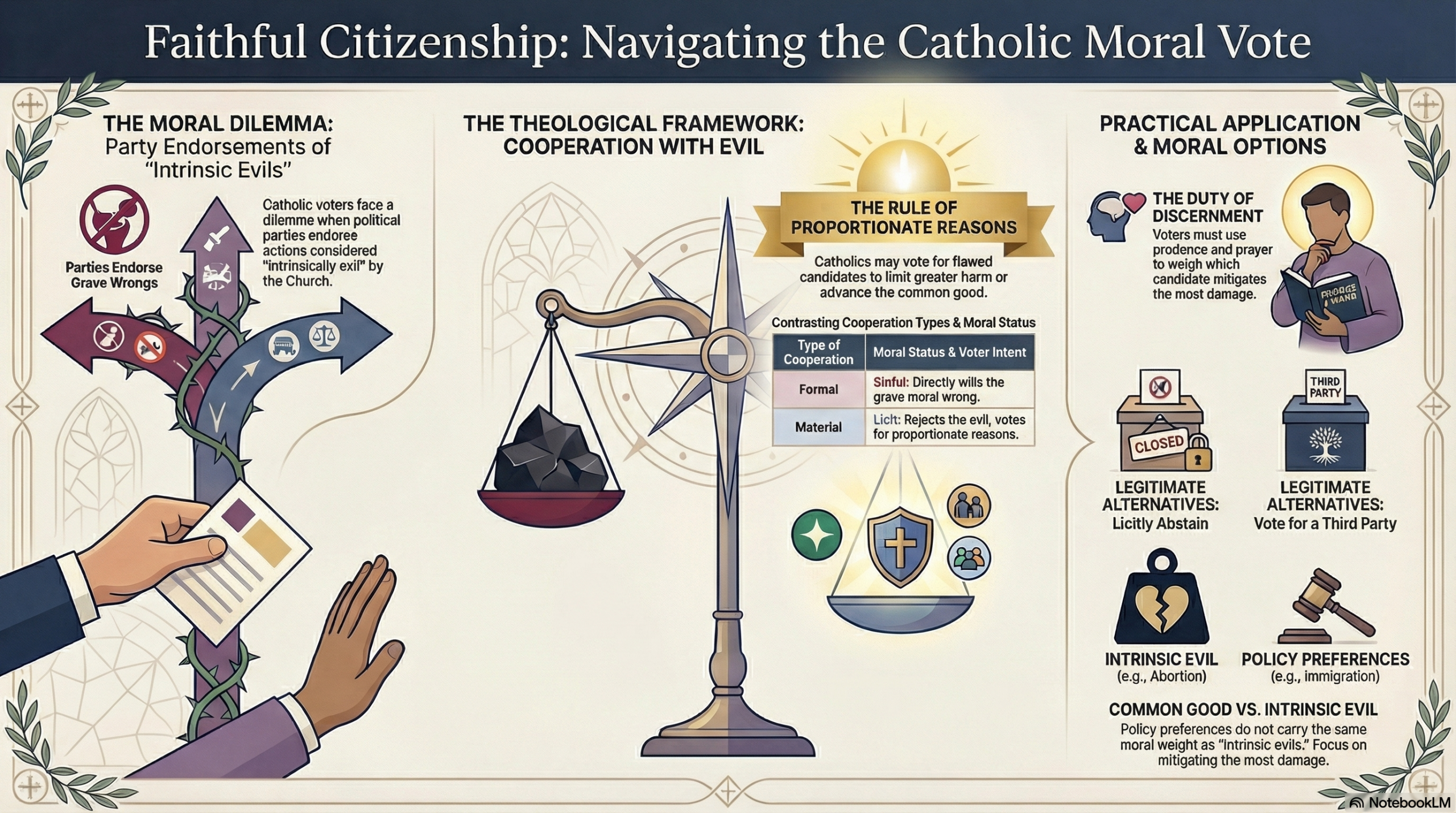
1. Introduction: The Voter’s Moral Landscape
In the journey of faith, the exercise of the franchise is rarely a simple selection between ideal options. We navigate a “fallen world” where political leaders are, at their best, “imperfect instruments” of the temporal order. For the person of faith, the political arena often presents a profound dilemma: how does one responsibly participate in civic life when candidates or platforms support positions that contradict fundamental moral truths?
Navigating this landscape requires more than mere partisan loyalty; it demands a specialized moral vocabulary. To maintain our integrity, we must understand the precise nature of how our individual choices connect to the systemic actions of those we elect. Without this clarity, we risk a gradual erosion of conscience. We must therefore form our judgments using the rigorous theological frameworks designed to evaluate “grave moral wrongs” in a pluralistic society.
Having laid the groundwork for our inquiry, we must first categorize the moral weight of specific acts, beginning with the concept of “Intrinsic Evil.”
——————————————————————————–
2. The Core Concept: Defining Intrinsic Evil
In moral theology, certain actions are classified as “intrinsically evil.” These are acts that are fundamentally incompatible with the good of the person and can never be justified, regardless of the actor’s intentions or the act’s circumstances. We prioritize these issues because they represent a direct assault on human life or an absolute violation of human dignity.
| Concept | Applied Examples from Text |
| Direct Killing of the Innocent | Abortion: The direct killing of the unborn through dismemberment, the crushing of the skull, and the trafficking of fetal remains for profit. Euthanasia: The direct ending of a life. |
| Violation of Bodily Integrity | Gender Ideology: The chemical sterilization of children and the surgical mutilation of the genitals of minors. |
| Corruption of the Vulnerable | Educational Malpractice: The placement of graphic pornography in K–12 classrooms to instruct underage children in the mechanics of rape and incest. |
Why prioritize these over policy issues? A crucial distinction exists between “intrinsic evils” and matters of prudential judgment, such as immigration or economic policy. While the source acknowledges that border security and the vetting of entrants are serious concerns for the common good, these are not “intrinsically evil” in the same absolute sense as the direct destruction of innocent life. Sovereign states possess the legitimate authority to regulate borders to protect their citizens, whereas no authority—state or individual—possesses the right to permit the destruction of the innocent or the mutilation of children.
Establishing the nature of these evils is the essential first step; however, we must now examine the architectural framework of our own involvement in such acts through the vote.
——————————————————————————–
3. The Mechanics of Cooperation: Formal vs. Material
When a candidate supports an intrinsic evil, the voter must determine the nature of their “cooperation” with that act. Moral theology distinguishes between two primary paths:
- Formal Cooperation (The Forbidden Path): This occurs when a voter “directly intends and wills the evil act itself.” In this context, it involves voting for a candidate precisely because of their support for grave moral wrongs like abortion or gender ideology. This is never permissible. As noted in our source, such an act renders the voter a participant in the evil, creating a state of spiritual unworthiness for Holy Communion.
- Material Cooperation (The Indirect Path): This is described as “indirect and remote” cooperation. Here, the voter fundamentally rejects the candidate’s immoral positions but casts a ballot for them for other, grave reasons.
Analogy for the Learner: Material cooperation may be likened to paying taxes that fund a municipal bridge. While you know the bridge may occasionally be used by those intending to commit a crime, you do not intend the crime yourself; rather, you support the bridge because it is necessary for the general commerce and movement of the community.
While material cooperation offers a narrow path of liceity, it is not a “blank check” for partisan preference; it requires the weight of “Proportionate Reasons” to balance the scale.
——————————————————————————–
4. The Scale of Judgment: Proportionate Reasons
Proportionate reasons are “exceptionally weighty” moral considerations that are grave enough to outweigh the evil being tolerated through one’s remote material cooperation. They are not matters of mere personal preference.
Moral Synthesis: Guidance from the Church
- Cardinal Ratzinger (2004): Clarified that while voting for a candidate because of their permissive stand on abortion is formal cooperation, voting for them despite that stand—in the presence of proportionate reasons—is licit material cooperation.
- U.S. Bishops (“Faithful Citizenship”): Emphasize that Catholics may only vote for a flawed candidate for “truly grave moral reasons” aimed at the common good, rather than narrow or selfish interests.
- The “So What?”: Proportionate reasons represent a genuine attempt to “limit greater harm” or protect fundamental goods, such as protecting the unborn through judicial appointments rather than allowing the legislative codification of expansive abortion permissions.
Having established the abstract moral architecture, we must now apply these principles to the concrete—and often agonizing—choices presented by current political candidates.
——————————————————————————–
5. Evaluating the Candidates: A Study in Moral Proportion
In a broken political system, the voter must exercise “prudence”—the virtue that allows us to choose the “lesser evil” to mitigate damage and protect the vulnerable.
- The Case Against the Left:
- Anthropological and Moral Crisis: The platform is viewed as advancing “demonic evil” through its institutional support for the dismemberment of the unborn and a rejection of traditional anthropology, which manifests in the chemical and surgical mutilation of children.
- Failure of the Common Good: The source highlights the “pure evil” of border policies that allowed unvetted, hostile actors to enter the country, resulting in a catastrophic failure of protection: the disappearance of 300,000 children, many of whom have been trafficked into slave labor or prostitution.
- Erosion of Civil Order: Criticisms include the ignition of racial tensions and the erosion of the privacy rights and physical safety of women by permitting biological men into private female spaces and competitive sports.
- The Case for the Conservative Option:
- Defense of the Rule of Law: A primary “proportionate reason” cited is the resistance to the “weaponization of justice.” This includes opposition to the fabrication of crimes, the use of “phony manuscripts” to justify the surveillance of political campaigns, and the subversion of the legal system to target political associates—tactics attributed to the opposition.
- Record of Protection: The candidate is presented as seeking to protect women and children from predation by illegal actors and domestic criminals, possessing a “record of accomplishments” that seeks to restore civil order.
- Moral Flaws Acknowledged: The voter must weigh the candidate’s support for In Vitro Fertilization (IVF)—which involves the creation and potential destruction of human embryos—as well as personal character flaws and “reprehensible” language.
- The Prudent Conclusion: Within this framework, the conservative option is evaluated as a means to mitigate systemic “demonic” evils, despite the candidate’s own significant moral shortcomings.
If, after such a rigorous evaluation, a voter finds that no primary candidate satisfies the requirements of a well-formed conscience, the tradition offers an “extraordinary step.”
——————————————————————————–
6. The “Extraordinary Step”: Abstention and Third-Party Voting
Faithful citizenship does not mandate participation in every specific race if the choices provided represent an unacceptable compromise of core principles.
- [ ] Abstention: This is a “principled protest.” By refusing to vote for any candidate in a specific race, the voter signals that the available options fail to meet the threshold of moral acceptability.
- [ ] Third-Party Voting: Casting a ballot for a minor-party candidate who aligns with Catholic principles is a licit, though often “symbolic,” act. It allows the voter to maintain moral consistency without providing even remote support for intrinsic evil.
Whether we choose to engage the two-party system or step outside it, the final arbiter of our moral responsibility is the internal sanctuary of the conscience.
——————————————————————————–
7. Conclusion: The Goal of Moral Integrity
The ultimate objective of the faithful citizen is not the discovery of a political savior, but the preservation of moral integrity while laboring for the common good. Our primary tools in this endeavor are prudence, a deeply informed conscience, and prayer.
As we navigate these decisions, we must keep the following in mind. Human rulers will always be flawed. Our duty is to reject formal complicity with evil, work tirelessly to mitigate the harm present in a fallen world, and trust ultimately in God’s providence over the outcomes of history.